
Override Details
Due to a MA law called Proposition 2 1/2, no matter how much costs rise, Reading’s primary revenue source—property tax—only increases 2.5% a year. The law was designed to keep taxes predictable, while giving voters the power to approve local tax increases beyond that amount as needed.
Over time, inflation has regularly exceeded the law’s 2.5% property tax limit, making it difficult for cities and towns to fund schools, public safety, and municipal services without seeking periodic overrides to bridge the gap.
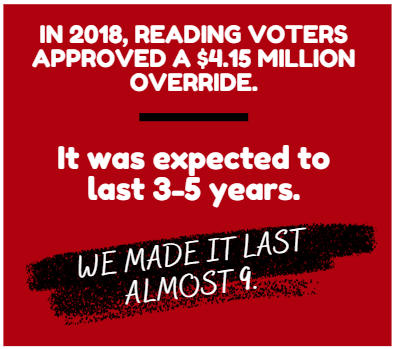
Due to these inflationary pressures and despite thoughtful town budgeting, Reading has increasingly relied on free cash to balance the operating budget, which is not sustainable for FY28 and beyond.
The Reading Select Board unanimously agreed on the need for an override and finalized the decision to place an operational override of $6.5 million on the state election ballot, held on November 3, 2026.
What is an Override?
How did we get here?
The FY27 budget is using $6.475M in free cash to balance the budget, which is not sustainable for FY28 and beyond. Accommodated costs, which are the things that we don't have any discretion over like employee benefits, energy bills, etc., have gone up by $9.8 million more than if they had only gone up by 2.5% per year. Despite that, the town is still only asking for $6.5 million to balance the budget because of cuts and cost savings elsewhere.
This wasn’t last minute! The Finance Committee and Select Board have been in discussion about the need for an override for over a year. The decision to place it on the ballot was voted on and finalized by the Reading Select Board on Tuesday, July 28, 2026.
Override Details
Financial Stewardship
How Much Will It Cost Me?
$736 per year for the average single-family assessment (based on FY26 data)
Don’t rely on averages.
Find out what an override will cost your household.