Vote YES for Reading is a nonpartisan municipal ballot question committee advocating for the passage of the $6.5M Prop. 2 1/2 override on November 3rd.
We are committed to providing accurate information about the override in order to empower voters to make the most informed decision on or before November 3rd. We will share information here on our website, as well as on our social media pages on both Instagram and Facebook, including data, video clips, and posts from Town of Reading officials about the implications on this important vote.
VOTE
NOVEMBER 3, 2026 at RMHS
Why Does Reading Need This?
Due to both Proposition 2 ½ and rising costs, town revenues can’t keep up with the operational needs
Due to a MA law called Proposition 2 1/2, no matter how much costs rise, Reading’s primary revenue source—property tax—only increases 2.5% a year
Over time, inflation has regularly exceeded the law’s 2.5% property tax limit, and Reading has had to increasingly rely on free cash to balance the operating budget and fund our schools, public safety, and municipal services
Reading is not alone! Just in FY26, 54 municipalities placed 74 override questions on local ballots (source)
It is not sustainable to continue to rely on free cash to balance the operating budget for FY28 and beyond
The Reading Select Board unanimously agreed on the need for an override and finalized the decision to place an operational override of $6.5 million on the state election ballot, held on November 3, 2026
This information and more can be found on Reading’s Town Proposition 2 ½ Override page
What is an override?
Override Details
Official Town of Reading Information
Official town presentations, municipal budget documents, Select Board minutes, and informational materials regarding the November 3, 2026 operational override are maintained and publicly available directly on the Town of Reading website.
Links to official Town Proposition 2½ Override page (readingma.gov)
How Does Reading Compare?
Average Per-Pupil Spending Data
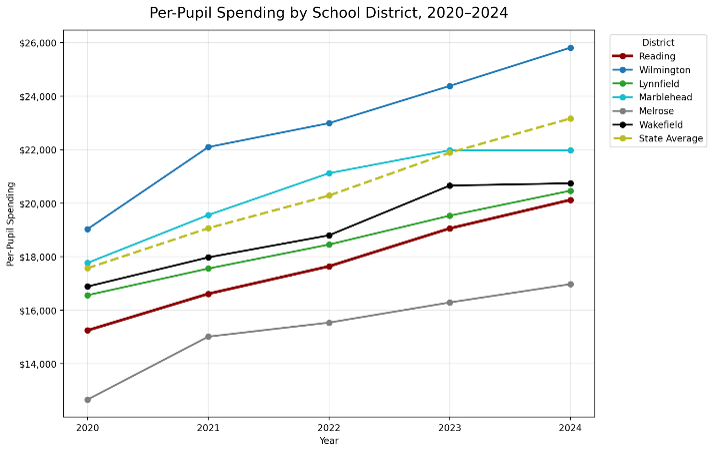
Reading currently spends far less per student than most of our neighbors and significantly less than the state average
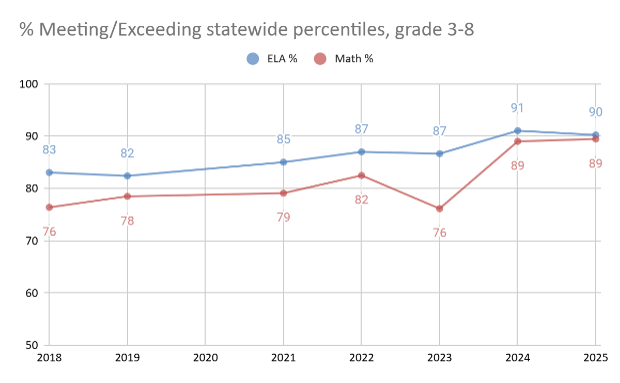
Reading's elementary test scores have improved dramatically in the years since the last override, which our former superintendent (Dr. Milaschewski) attributes to the addition of assistant principals and adjustment counselors at the elementary school level, allowing principals and teachers to focus on instruction
Tax Rate Comparison
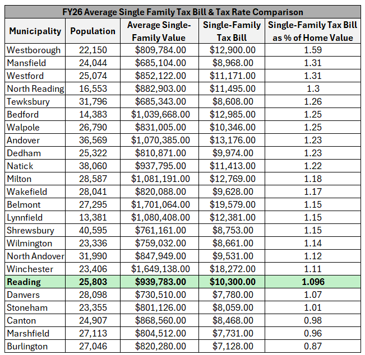
Reading’s tax rate is highly competitive among its immediate neighbors (source)
Homeowners in Reading face a lower tax percentage on their property value than those in Lynnfield, Wilmington, Wakefield, and North Reading